
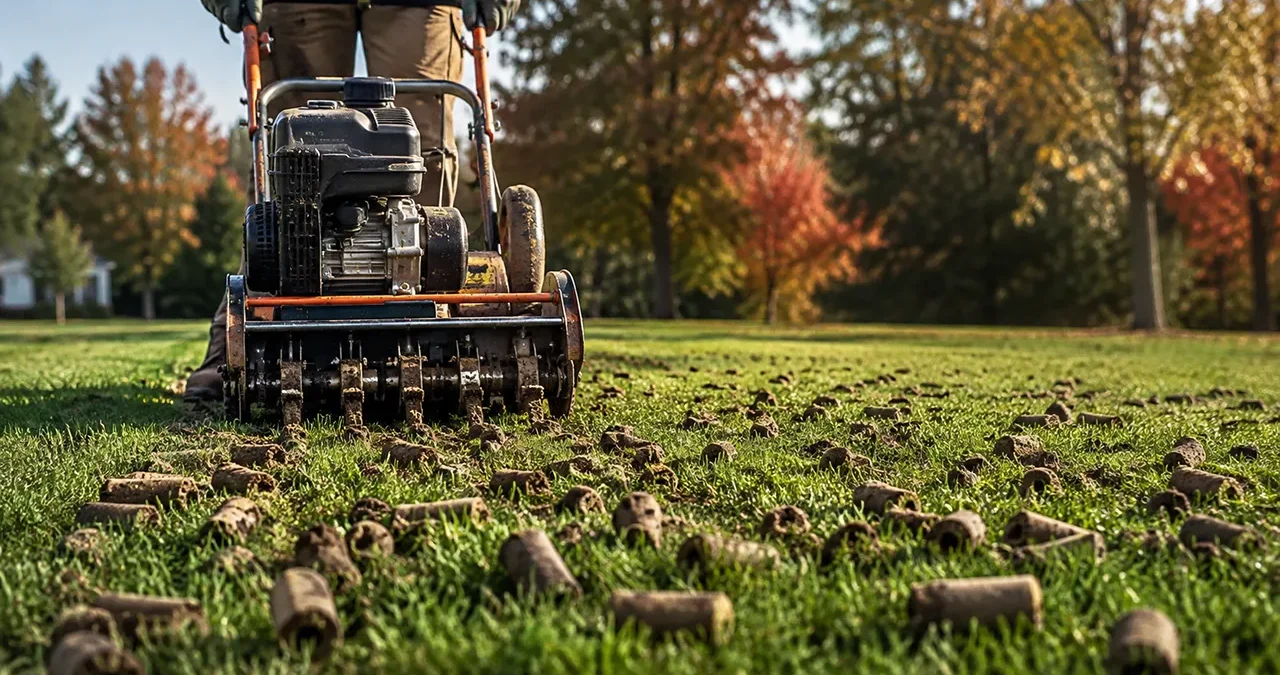
Aeration and overseeding cost in Wichita typically runs $175 to $500 for a standard residential lawn. Core aeration alone lands near $75 to $200, and overseeding adds roughly $100 to $350 on top. Lawn size and seed blend drive most of that spread, and properties above a half acre commonly run $500 or more.
- $175 to $500 typical project
- $0.10 to $0.40 per sq ft
- Free on-site estimate
That is the short answer. The longer answer is that quotes for the same yard can differ by a few hundred dollars, and the reason usually comes down to how much seed goes down and what kind. Below is what those numbers actually cover, what moves them, and what to look for before you say yes to a quote.
What Does Aeration and Overseeding Cost in Wichita?
Published pricing for the Wichita market falls into fairly consistent bands once you sort it by lawn size. These are general market ranges, not a quote. Every lawn is different, and the only accurate number comes from someone standing in your yard.
| Service | Typical Wichita range | What drives it |
|---|---|---|
| Core aeration only | $75 to $200 | Turf square footage, access, obstacles |
| Overseeding only | $100 to $350 | Seed quantity and seed quality |
| Aeration and overseeding together | $175 to $500 | Both of the above |
| Half acre or more of turf | $500 to $1,200 and up | Volume of seed, time on site |
Another way to sanity check a quote is per square foot. Across the Wichita market, combined aeration and overseeding generally works out to somewhere between $0.10 and $0.40 per square foot of actual turf. If a number lands far outside that, it is worth asking what is different.
Ranges are for budgeting. A measured lawn is what turns one into a real number.
What Makes One Quote Higher Than Another?
Five things account for most of the difference between two quotes on the same property.
- Turf square footage, not lot size. A 10,000 square foot lot with a house, driveway, and patio might only have 5,000 square feet of actual grass. Good quotes measure the grass.
- Seed blend. This is the single biggest swing. A basic contractor blend and a quality turf-type tall fescue blend can differ by more than double per pound, and a typical overseed uses a lot of pounds.
- Seeding rate. K-State puts the normal tall fescue seeding rate at 6 to 8 pounds per 1,000 square feet, with overseeding at roughly half that. A quote built on a thin rate will look cheaper and perform worse.
- Number of passes. Compacted Wichita clay often needs two passes in different directions to pull enough plugs. One pass costs less and does less.
- Obstacles and access. Tight gates, steep slopes, heavy tree roots, and a lot of beds all slow the work down.
Starter fertilizer is sometimes bundled and sometimes quoted separately. If you are comparing two numbers, check whether fertilization is inside one of them and not the other.
Why Is Fall the Best Time to Aerate and Overseed in Kansas?
Cool season grasses put on root growth in fall, and new seed germinates in warm soil under cooling air. That combination only lines up for a few weeks a year in this part of Kansas.
K-State Research and Extension names early to mid September as the best window for seeding tall fescue and Kentucky bluegrass, and treats October 15 as the practical last date for safe fall seeding. In the Wichita area that generally means aerating and overseeding from early September through the first week or two of October.
Seed that goes down after that cutoff may germinate, but it often will not root deeply enough to survive the first hard freeze. That is money spent twice. If you are weighing the calendar, our guide on when to overseed your lawn in Wichita walks through the timing in more detail.
If you are planning this for the fall, the calendar is the constraint, not the budget.
Do You Need Both Services, or Just One?
They solve different problems, and paying for the wrong one is a common way to waste a few hundred dollars.
Aeration alone makes sense when your lawn is reasonably thick but the soil is hard, water runs off instead of soaking in, or the turf feels spongy underfoot. Wichita’s clay-heavy soil compacts quickly, especially in yards with kids, dogs, or regular foot traffic.
Overseeding alone rarely makes sense here. Seed dropped onto compacted, un-aerated ground has poor seed to soil contact, and germination suffers.
Both together is the standard recommendation for thin, patchy, or worn lawns. The aeration holes give seed a protected place to land, hold moisture, and make contact with soil. That is why aeration and overseeding are usually sold as one service rather than two.
Thicker turf also crowds out weeds, which reduces what you spend on weed control the following season.
What Should a Quote Include?
Before you approve anything, a clear quote should tell you:
- The measured turf square footage the price is based on
- The seed type and blend, by name
- The seeding rate in pounds per 1,000 square feet
- How many aeration passes are included
- Whether starter fertilizer is included or separate
- What you are responsible for afterward, specifically watering
If a quote is a single number with no detail behind it, ask for the breakdown. A company that measured your lawn will have it ready.
What Does Your Lawn Need After the Service?
The watering is on you, and it is the step that decides whether the money was well spent. New seed needs consistently damp soil for the first three to four weeks. Short, frequent watering beats long, deep soaking during germination, which is the opposite of normal summer watering.
A working sprinkler system makes this considerably easier. If yours has dry spots or heads that are not turning, it is worth sorting out before the seed goes down rather than after.
Leave the soil plugs where they fall. They look untidy for a week or two, then break down and return nutrients to the lawn. K-State’s tall fescue guide covers the follow-up care in depth.
Hold off on mowing until the new grass reaches roughly three inches, and skip broadleaf weed control until the seedlings have been mowed two or three times. Ongoing lawn care can pick back up after that.
Frequently Asked Questions
How much does it cost to aerate and overseed a lawn in Wichita?
Most Wichita homeowners see combined aeration and overseeding quotes between $175 and $500 for a standard residential lawn. Turf square footage and seed blend account for most of the variation. Properties with a half acre or more of grass commonly run $500 and up.
Is aeration and overseeding worth the money?
For a thin, patchy, or compacted lawn, yes. It is one of the few lawn services that addresses the underlying soil problem rather than treating symptoms. On an already thick, healthy lawn in loose soil, the return is smaller and the service can often wait a year.
When is the last day to overseed in Wichita?
K-State treats October 15 as the practical cutoff for fall seeding of cool season grass in Kansas. Seed planted after that often germinates but fails to root deeply enough to survive winter, which means paying for the same work again in spring.
How long until I see results?
Tall fescue typically germinates in seven to fourteen days with consistent moisture. Expect visible fill-in within three to four weeks and the real payoff the following spring, once the new grass has established a full root system through winter.
Can I aerate and overseed myself?
You can. Walk-behind core aerators rent for roughly $95 a day in the Wichita area, and towable units run closer to $50 if you have a vehicle with a hitch. Add seed, fuel, and a Saturday, and the gap narrows quickly. Machine weight and hitting the right seeding rate are the usual sticking points.
Get a Number for Your Actual Lawn
Market ranges are useful for budgeting and useless for deciding. The only figure that matters is the one measured against your turf, your soil, and your seed choice.
Elite Landscape Solutions provides aeration and overseeding across Wichita, Andover, Derby, Maize, Goddard, and the surrounding communities. The fall window is short in Kansas, so if you are planning this year, earlier is better than later.
Request a free estimate and we will measure your lawn and walk you through exactly what your quote covers, or call and we will answer your questions on the phone.